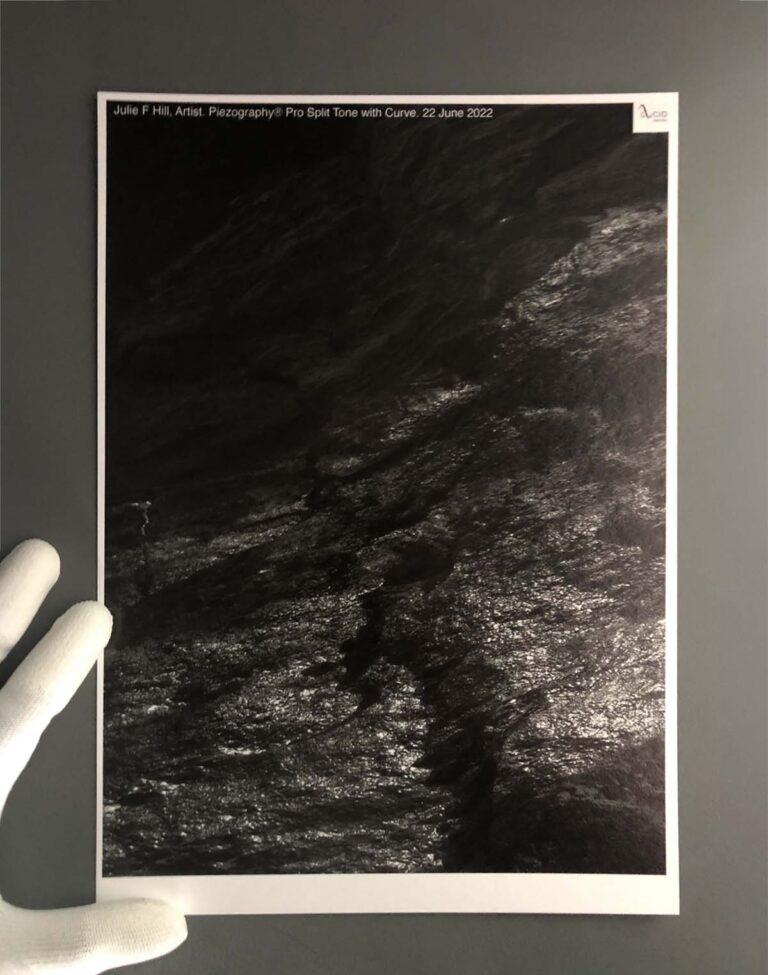
Yesterday, I welcomed UK artist, Julie Hill, to the Lucid Imaging print studio to make Piezography® Pro and wide-gamut colour test prints from one of her superb geological-based photographs. Before getting down to making prints, I wanted to learn more about Julie’s fascinating practice and her work, which provides context and informs my input for the making of fine art prints.
TLDR; Piezography® Pro for the win
Julie had previously uploaded a few of her wonderful lowkey images for me to review in preparation for testing. Upon opening one of the files, my initial reaction was a sharp intake of breath – the dark tones and texture were fabulous and inviting. Mediating the image through a screen had generated a sensation in me that had me immediately contemplate a physical print. Julie had already conveyed she wanted to print this image large without losing any integrity within the print and had considered a colour vs black and white version.
Back to our day of print testing, I was delighted Julie chose to work with the image I was so taken by. Having looked at some paper options, Julie chose Hahnemühle FineArt Baryta as the media to test. After some digital processing in Photoshop, we tested the first resolution and colour/tonal prints on our large format wide-gamut colour printer, the subtle warm tones were evident and the overall density impressive.
The next step was to test the print on our large format carbon pigment Piezography® Pro printer. The result was exceptionally neutral, however, adjacent to the colour print, the pure black/white monochrome print looked somewhat flat. I knew what the image required to exhibit the depth and power of a sensational Piezography® Pro print. Switching my display to the Piezo calibration, I created a new edit that exhibited depth and just enough details in the shadows to pique curiosity. Add to the new edit split-toning to add warmth to the mid-tones and shadows, the final test print delivered a depth and quality that allowed the eye to explore the print, taking in details initially unnoticed.
Without a doubt, the Piezography® Pro print exceeded the wide-gamut colour in detail, depth and character.
Collaborating with Julie to make her prints was an enjoyable experience with a wonderful tangible outcome: test prints she was happy with. My advice to Julie was to hang the prints somewhere she would pass them regularly to be with them and see what caught her eye. During the session, the more I looked at the monochrome split-tone carbon pigment print, the more I felt I would have been proud to have made this photograph. Julie and I discussed the idea of space being unreachable for most, so too is the prospect of me making that photograph – at this point in time, I couldn’t see me climbing a mountain to make an image like that on the way down.
Expect an update from the unsteady hand phone picture of the print in due course.
About Hahnemühle FineArt Baryta
Weighing in at a substantial 325 gsm, the bright white FineArt Baryta is 100% alpha cellulose paper. Although the paper has a “moderate” optical brightening agent (OBA) content and could be seen glowing in our light booth under UV light, Hahnemühle guarantees archival standards. Benefiting from a high d-max of photo black ink on glossy paper, both of our chosen print processes delivered prints that allowed the image to shine without the shine (gloss index) overpowering the photograph – the rough or dry textures within the image maintained their characteristics and conveyed the appropriate sensation. The prints looked and felt like photographs.
Hahnemühle FineArt Baryta Datasheet
giclée
although giclée is a term I adopted early in my print experience, over the last several years I have been using the term archival pigment print to better describe our inkjet prints, for example:
wide-gamut colour archival pigment print
and now,
Piezography® Pro archival carbon pigment print
Interested in trying Piezography® Pro? Book a test session.